
How to Rewrite What AI Says About You (Without Touching the Code)



How to Rewrite What AI Says About You (Without Touching the Code)
AI Doesn’t Think — It Assembles
The most powerful large language models today — ChatGPT, Claude, Gemini, Perplexity — don’t form opinions. They don’t verify facts. They assemble summaries based on what’s available.
That means if you’re a founder, CEO, public figure, or brand — AI will present you to the world not as you are, but as the internet says you are.
And it will do so without your approval, review, or context.
This is not theoretical. If you ask ChatGPT or Gemini to describe a company, founder, or public figure, it will confidently return a biography. Often without revealing where the information came from — and sometimes, without acknowledging that it’s outdated, wrong, or missing entirely.
The good news: you don’t need to code, sue, or game the algorithm to fix it.
The better news: you can reshape what AI says — using the same signals it listens to.
Where AI Gets Its Facts
This article builds on the core insight of What AI Forgot: The Silent Power of Wikipedia:
AI’s answers reflect the structure of human-edited knowledge.
That’s why the inputs matter more than the outputs.
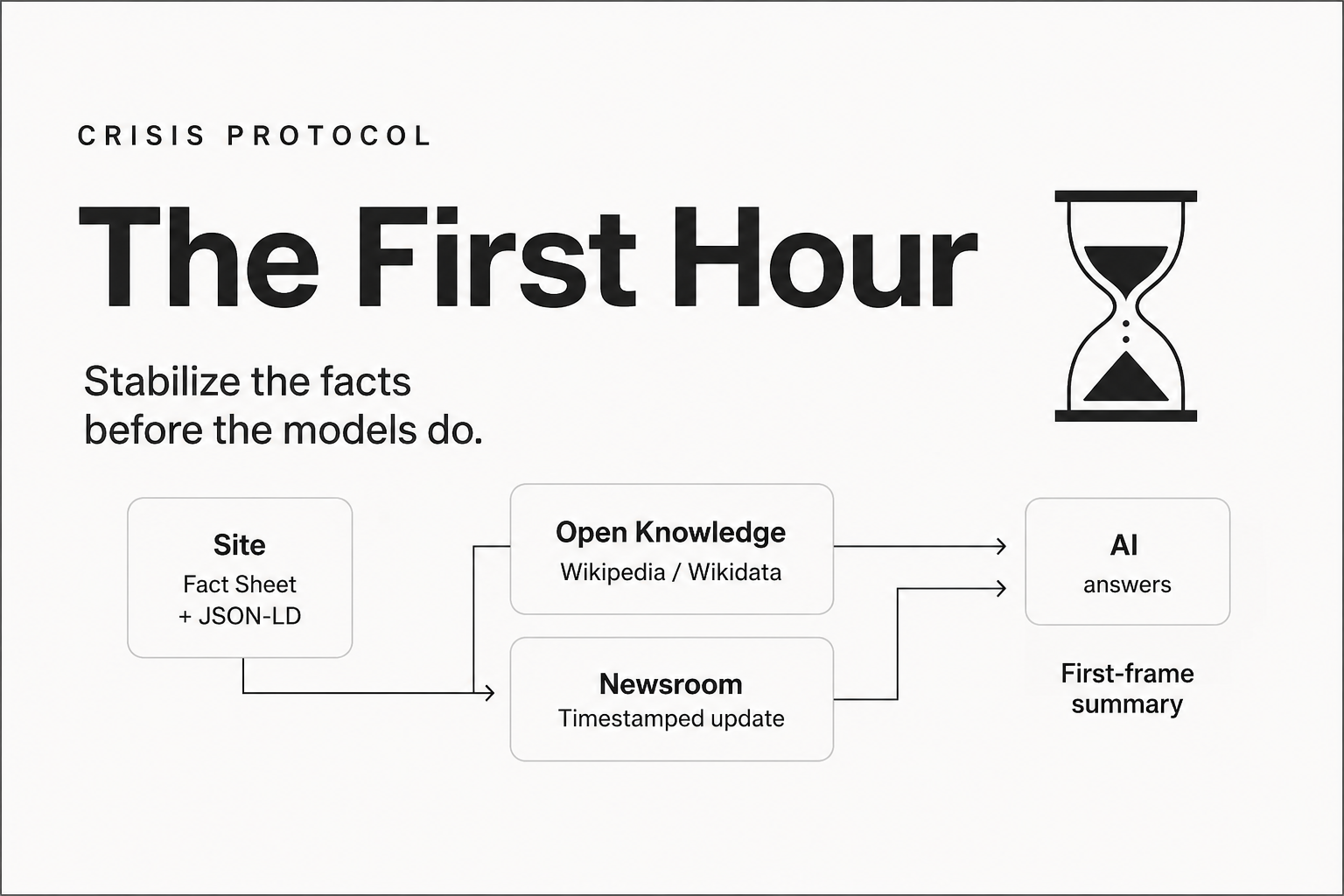
Most LLMs summarize from a predictable combination of:
- Wikipedia → Primary structured knowledge layer
- News media → Authority + recent relevance
- Official websites & bios → Identity anchors
- Social profiles → Tone, reputation, links
- Databases → Crunchbase, LinkedIn, Google Scholar, etc.
- Echoes → Aggregators, AI-written blurbs, review sites, ghost listings
If these layers are empty, shallow, or misleading, that’s what AI sees. That’s the story it builds.
How to Reshape AI’s Summary Without Touching the Code
This is the core of AI-era reputation work: You change the answer by changing the signals.
Here’s how:
1. Wikipedia First — or Nothing Else Will Matter
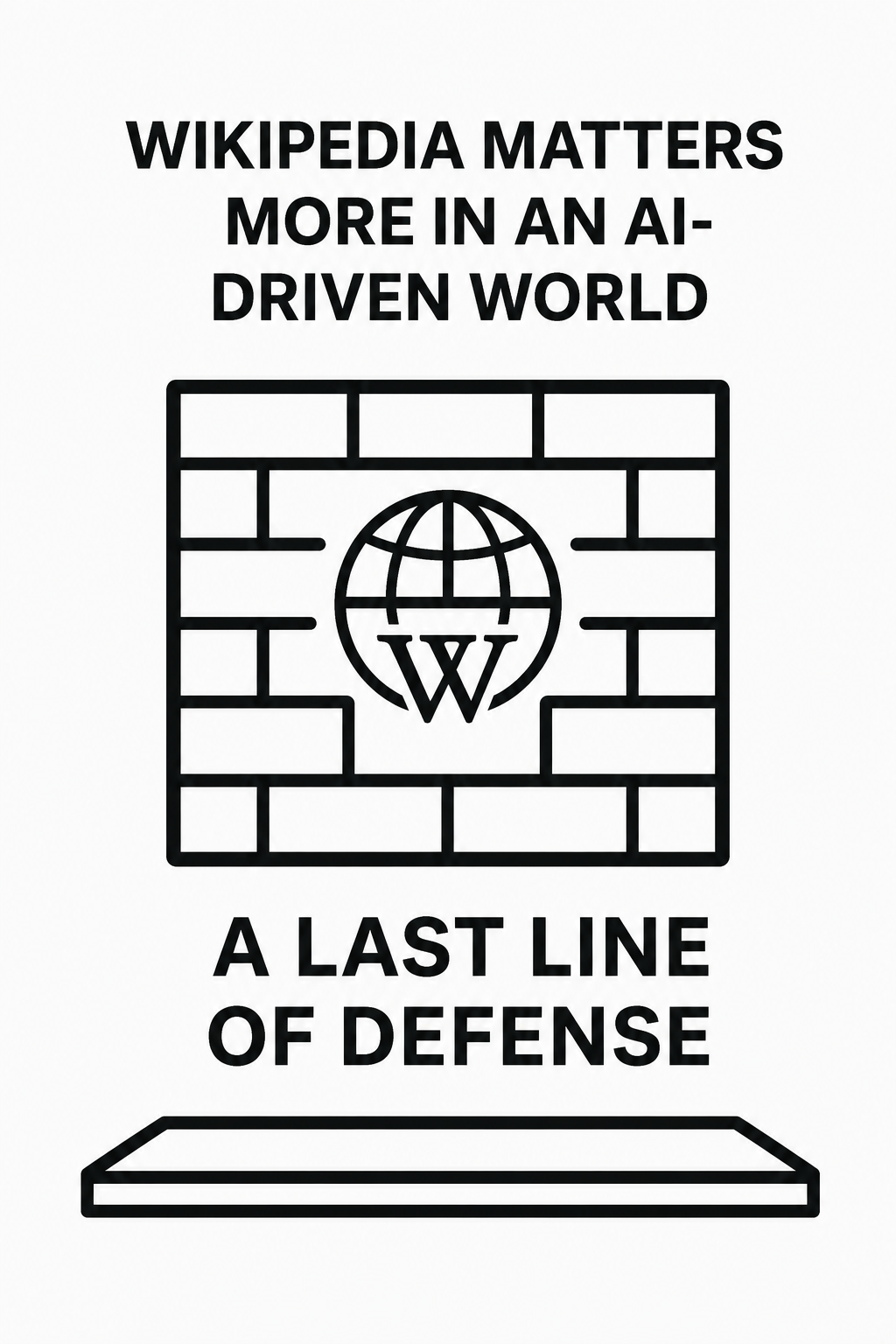
If you’re notable enough to have a Wikipedia page, it’s likely the single most influential document shaping how AI sees you.
Even ChatGPT (which doesn’t cite sources by default) heavily leans on Wikipedia language, structure, and dates.
A well-maintained Wikipedia article:
- Anchors your identity and roles
- Influences AI’s tone and priority
- Provides sourcing for third-party facts
If you don’t have a Wikipedia page, and you’re eligible under notability rules, consider suggesting one via Talk Pages and editors — ethically and transparently.
If you do have one, check that it is:
- Up to date
- Sourced to strong third-party references
- Balanced in tone
- Reflective of your current position
A half-dead Wikipedia page is worse than none at all.
2. Press Coverage: The Second Layer of Trust
AI ranks sources by reliability. A short feature in a recognized media outlet can weigh more than a full-page biography on your own site.
That doesn’t mean chasing PR for its own sake.
It means publishing in places that machines — and humans — consider trustworthy.
Example: A founder featured in Forbes, Handelsblatt, or WIRED will be reflected as such in summaries, even if their LinkedIn is sparse.
Media reinforces Wikipedia. It also makes Wikipedia citations possible.
3. Structured Data: Crunchbase, LinkedIn, etc.
Your Crunchbase, LinkedIn, and public company registry entries may not feel important — but AI tools scan them.
- Crunchbase fills in company data
- LinkedIn helps resolve people with similar names
- ORCID / Google Scholar does the same in academia
- Company websites (with schema markup) can anchor core facts
Correcting these is fast. Ignoring them is expensive.
4. Your Official Site: Identity Infrastructure
Think of your website as the stable layer.
It should:
- Reflect your current role, mission, and identity
- Include a short third-person bio (AI loves these)
- Offer a clear press/media page
- Be structured with basic metadata (schema.org etc.) if possible
This is the only layer you fully control. Yet many skip it.
5. The Social Layer: Personality, Proof, Context
Social media isn’t just performance anymore — it’s signal generation.
- AI sees followers and engagement, but also:
- Posts, affiliations, tone, and links to articles
You don’t need to be loud, viral, or everywhere. But you should at least be visible — or someone else will be.
How Long Until AI Reflects the Change?
AI models don’t all learn at the same pace — or from the same sources. Understanding the difference can help you time and target your updates more effectively.
Snapshot Models
Examples: ChatGPT (default), Claude, Mistral
These are trained on fixed datasets. Once trained, they don’t learn anything new until a future version is released — which might happen every few months or even once a year.
- GPT-4-turbo’s cutoff is December 2023 — nothing after that is part of its “knowledge.”
- An updated Wikipedia page, news article, or personal website won’t be visible until a future release (like GPT-5), if it’s included at all.
- These models are great at reflecting what was, but blind to what’s new.
Live or Hybrid Models
Examples: Perplexity, Gemini 1.5, ChatGPT with browsing enabled
These models can pull information from the current web — either in real time or through search integrations.
- Wikipedia edits can be reflected within days, if the page is crawled and indexed.
- News coverage is picked up quickly, especially on major outlets.
- Your personal or company website becomes critical — but only if it’s public, well-structured, and easy to crawl.
Bottom line:
If the AI assistant uses real-time search, your changes will show up fast.
If not, you’re planting signals for the next training round — and for everyone using AI-generated summaries in content, search, or automation.
Why Outputs Reflect the Strongest Signals
This is not a neutral process. AI doesn’t return the most accurate story. It returns the most verifiable one — based on the strongest, clearest, most repeated signals.
That’s why your story isn’t just what you’ve written.
It’s what others have written, what’s been cited, and what fits the machine’s pattern for truth.
If your digital presence is weak, AI fills the gaps.
Sometimes with outdated facts. Sometimes with another person’s identity.
Sometimes with complete invention.
A Conductor for the Signal Orchestra
By now, you might be wondering: how do I manage all these layers?
That’s the wrong question.
The right one is: Who manages them for me?
We’ve moved past the era of SEO specialists and PR flurries.
Reputation in an AI-driven world is not about clicks or spin. It’s about signal design — and orchestration.
- The source layer: Wikipedia, registries, press
- The profile layer: LinkedIn, Crunchbase, Google Scholar
- The owned layer: your site, bio, newsletter
- The social layer: consistency, tone, connection
If you leave one layer silent, the machine fills it.
If you leave all of them silent, the machine writes your story for you.
AI doesn’t invent your story — unless you let it.
You don’t need to hack the code.
But you do need to shape the source.
This is reputation work in the age of the machine.
References
- Shumailov et al. (2023). The Curse of Recursion: Training on Generated Data Makes Models Forget. arXiv.
- Wikipedia contributors. (2024). Model collapse. In Wikipedia, The Free Encyclopedia.
- Nature (2024). AI models collapse when trained on AI-generated data. https://www.nature.com/articles/s41586-024-07566-y
- OpenAI. (2023). How ChatGPT uses browsing and plugins. https://help.openai.com
- Perplexity.ai. (2024). How Perplexity Answers Questions Using Real-Time Sources. https://www.perplexity.ai/about
Related Blogs

KI hat bereits eine Meinung über Sie
Was KI im Jahr 2026 über Sie sagt – und warum Sie das nicht dem Zufall überlassen sollten.
Reputation is now infrastructure
Jahrzehntelang wurde Reputation als Kommunikationsproblem behandelt.

.png)