
Why Does AI Describe Our Company Incorrectly?



Why Does AI Describe Our Company Incorrectly?
Many executives have experienced the same moment.
Out of curiosity, they open ChatGPT, Gemini, Claude or another AI system and ask a simple question:
“What does our company do?”
The answer appears.
And almost immediately they think:
“That’s not how we would describe ourselves.”
Sometimes the description is incomplete.
Sometimes it is outdated.
Sometimes it focuses on the wrong products, the wrong market, the wrong strengths or even the wrong period in the company’s history.
The natural reaction is often:
Why is AI getting our company wrong?
The answer reveals something important about how AI systems work.
AI Does Not Read Your Strategy Deck
Organizations understand themselves through strategy.
They know their ambitions, positioning, vision and goals.
AI systems do not.
AI systems can only work with the signals available to them.
When an AI system describes a company, it does not consult the CEO, the marketing team or the latest strategy presentation.
Instead, it constructs an understanding from information it can access across the digital ecosystem.
This may include:
- Corporate websites
- News coverage
- Structured data
- Wikipedia
- Social media platforms
- Podcasts and interviews
- Industry reports
- Public filings
- User-generated content
- Third-party websites
The result is not a direct reflection of how a company sees itself.
It is a reflection of the signals surrounding that company.
AI Constructs Representations
One of the biggest misconceptions about AI is the idea that it stores a single description of every organization.
Modern AI systems generally do not work that way.
Instead, they construct representations.
An AI Representation is the understanding a machine system forms about an organization based on available signals.
Just as two humans can develop different impressions of the same company, different AI systems can arrive at different representations.
This is why ChatGPT, Claude, Gemini and Perplexity may sometimes describe the same organization differently.
Each system may weigh available signals differently.
The Representation Gap
Most organizations have an intended positioning.
They know how they want to be understood.
AI systems, however, construct their own representation from available evidence.
The difference between these two realities creates what we call the Representation Gap.
The larger the gap, the more likely executives are to feel that AI is describing their organization incorrectly.
The problem is not necessarily that AI is wrong.
The problem is that machine understanding and organizational intent have diverged.
Why AI Often Focuses on the Wrong Things
AI systems are designed to identify patterns.
They often prioritize information that appears:
- Frequently
- Consistently
- Across multiple sources
- In authoritative environments
This creates an interesting challenge.
Organizations often focus on what they want people to know.
AI systems focus on what the signal environment suggests is most important.
For example:
A company may have repositioned itself from a software provider to an AI company.
Internally, this shift may be complete.
Externally, however, the majority of available signals may still describe the organization as a software provider.
As a result, AI systems may continue to generate descriptions that no longer reflect the company’s intended positioning.
The Problem Is Usually Not the AI
When executives encounter an inaccurate AI description, they often assume the problem lies within the model itself.
In reality, the issue frequently originates upstream.
The quality of machine understanding depends on the quality of machine-readable signals.
If those signals are:
- Inconsistent
- Fragmented
- Outdated
- Contradictory
- Weakly distributed
then AI systems will struggle to construct an accurate representation.
The output is often a symptom.
The signal environment is often the cause.
From Outputs to Signals
Most organizations focus on outputs.
They ask:
“How do we change what AI says?”
A more useful question is:
“Why did the AI arrive at this understanding?”
This shifts attention from the answer to the inputs.
Once organizations understand which signals contribute to machine understanding, they can begin improving those signals.
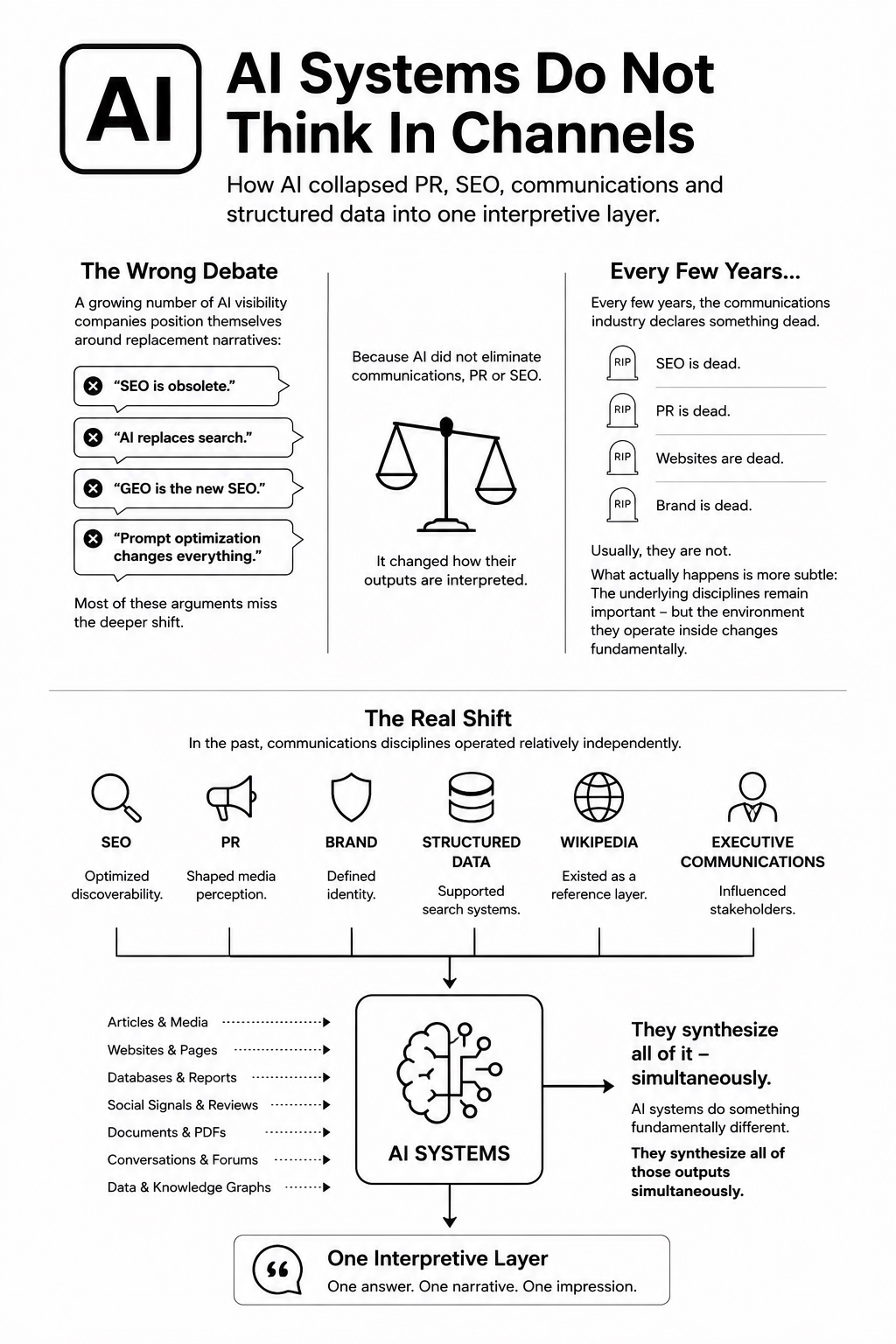
This is where communications, reputation management, SEO, structured data, content strategy and digital presence begin to converge.
Historically these disciplines operated separately.
AI systems increasingly treat them as one interconnected signal environment.
AI Perception Layering
AI Perception Layering (APL) is a framework for understanding how AI systems form representations of organizations based on available signals.
Rather than focusing solely on AI outputs, APL focuses on the signals that shape machine understanding.
The framework starts with a simple observation:
Organizations do not control AI-generated answers.
But they can influence the signals from which those answers emerge.
Understanding those signals is the first step toward reducing the Representation Gap and improving AI Representation.
The New Strategic Question
For years, organizations asked:
“What do people think about us?”
Increasingly, a second question is becoming important:
“What does AI think about us?”
The answer matters because AI systems are becoming intermediaries between organizations and their stakeholders.
Investors use AI.
Customers use AI.
Journalists use AI.
Employees use AI.
Partners use AI.
The challenge is no longer simply managing reputation.
It is understanding how machine systems construct representations in the first place.
Conclusion
AI does not describe companies incorrectly because it is intentionally inaccurate.
More often, AI reflects the signal environment available to it.
When organizations encounter inaccurate, outdated or incomplete AI-generated descriptions, the most useful question is not:
“How do we fix the answer?”
The more useful question is:
“What signals caused the answer?”
Because once the signals are understood, organizations can begin improving the representation that emerges from them.
Related Blogs

What AI Forgot: The Silent Power of Wikipedia
Inside the crowdsourced mind that still teaches the machines — how our last human knowledge source became the backbone of artificial intelligence and why we can’t afford to lose it in an AI-driven world.

Make Your Site Machine-Literate: The LLM-Ready Homepage Checklist
In an era where search engines and AI assistants answer questions directly, your website isn’t just a brochure. It’s the canonical place machines look to anchor your facts. If you structure it correctly, you reduce errors, disambiguate your brand and executives, and give models a stable source to summarize.

.png)