
Make Your Site Machine-Literate: The LLM-Ready Homepage Checklist


Make Your Site Machine-Literate: The LLM-Ready Homepage Checklist
In an era where search engines and AI assistants answer questions directly, your website isn’t just a brochure. It’s the canonical place machines look to anchor your facts. If you structure it correctly, you reduce errors, disambiguate your brand and executives, and give models a stable source to summarize.
Why this matters
Search systems use structured data to understand entities (people, organizations, products) and power results like logos, knowledge panels, and rich snippets; Google explicitly recommends JSON-LD for that markup.
Google’s knowledge panels draw on the web and other sources (often including Wikipedia/Wikidata), so your site needs to assert the same facts, in machine-readable form, to avoid drift.
Bing also supports schema.org structured data for understanding and indexing content.
The LLM-Ready Homepage: 10-point checklist
1) Declare the entity.
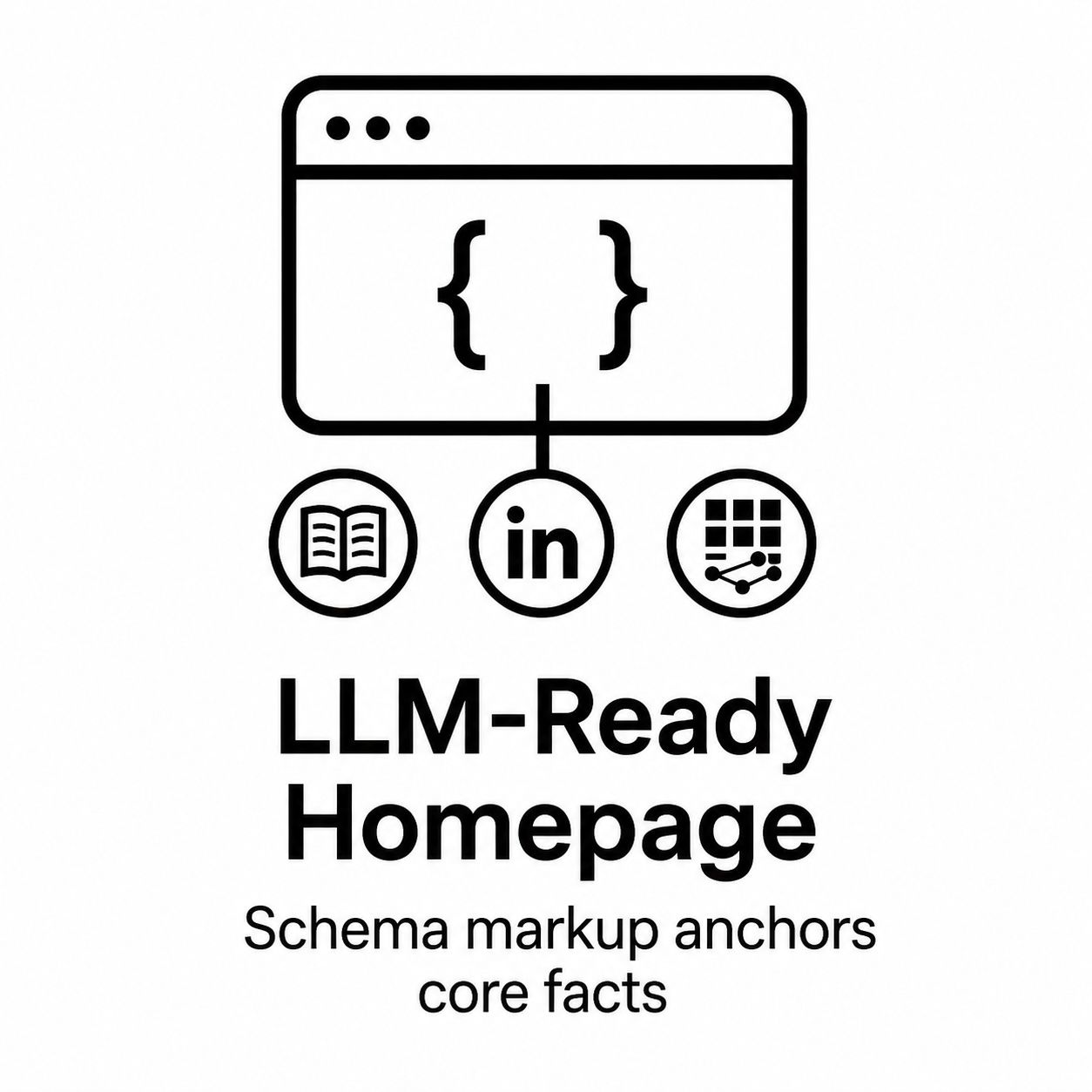
Add Organization (and Person for leaders) in JSON-LD on your homepage. Include legal name, URL, foundingDate, HQ, and top officers. This helps disambiguate you from look-alikes.
2) Use sameAs to knit your identity.
Point to authoritative profiles (Wikipedia, Wikidata, LinkedIn, Crunchbase, official socials). sameAs tells machines “these links are the same entity.”
3) Mark up leadership profiles.
Give each executive a crawlable bio URL and add Person JSON-LD (name, jobTitle, affiliation, image). Link back and forth (org → person, person → org).
4) Mark up products and services.
Use Product/Service with key properties (name, description, brand, offers if applicable). Keep names consistent with press and docs.
5) Publish a canonical “About/Fact Sheet.”
A single page that states your non-negotiable facts (legal name, founding year, ownership, locations). Keep a dated PDF mirror and link it.
6) Align metadata and technical hygiene.
Clear titles/descriptions, canonical tags, sitemap.xml, no accidental noindex, and a robots.txt that doesn’t block key pages.
7) Standardize media assets.
Expose a square logo and primary brand image and reference them in Organization.logo. Consistency reduces mismatched logos in search.
8) Timestamp important pages.
Show last-updated dates on leadership, About, and product pages; AI systems and search features value freshness cues.
9) Validate your markup.
Run Google’s Rich Results Test (and re-test after every release). It catches syntax errors and shows eligibility for rich features.
10) Keep a change protocol.
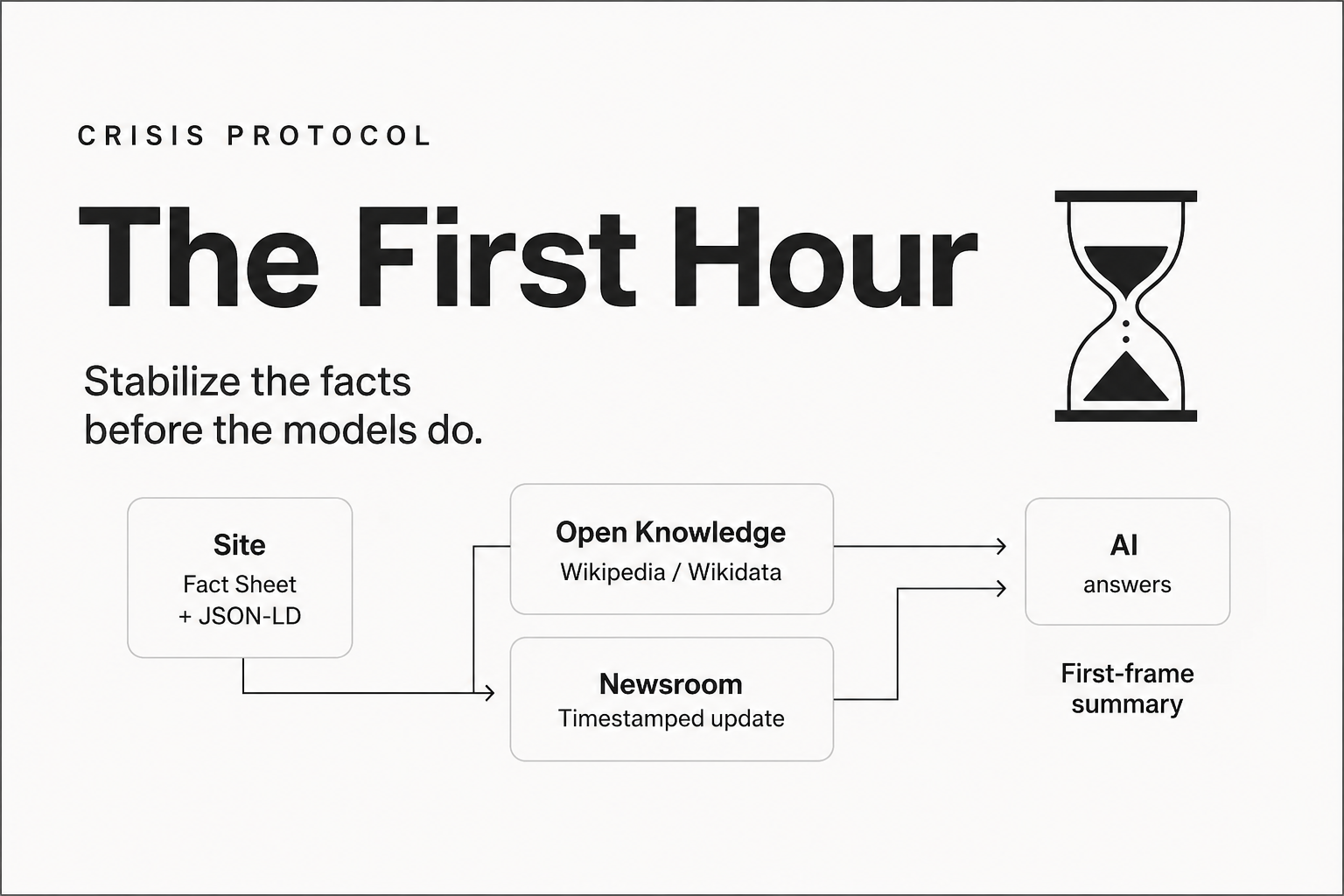
When leadership, HQ, or brand elements change, update: homepage JSON-LD → executive bios → sitemap → press page → (where appropriate) Wikipedia/Wikidata. Consistency across surfaces helps machines converge on one truth.
Minimal JSON-LD starter (paste in<head>)
<script type=”application/ld+json”>
{
“@context”: “https://schema.org",
“@type”: “Organization”,
“name”: “Example AG”,
“legalName”: “Example Aktiengesellschaft”,
“url”: “https://www.example.com",
“logo”: “https://www.example.com/assets/logo-square.png",
“foundingDate”: “2018–05–10”,
“founder”: {
“@type”: “Person”,
“name”: “Alex Beispiel”
},
“address”: {
“@type”: “PostalAddress”,
“streetAddress”: “Musterstraße 1”,
“addressLocality”: “Berlin”,
“postalCode”: “10115”,
“addressCountry”: “DE”
},
“sameAs”: [
“https://www.wikidata.org/wiki/QXXXX",
“https://en.wikipedia.org/wiki/Example_AG",
“https://www.linkedin.com/company/example"
]
}
</script>
(Adapt for executives with a /people/alex-beispiel page using @type: “Person” and affiliation back to the org.)
Practical pitfalls to avoid
- Conflicting facts (different founding years across pages)
- Uncrawlable bios (PDF only; no HTML page)
- Generic About copy (no concrete facts to extract)
- Old logos/filenames (machines keep using the wrong asset)
- Broken sameAs (links to unofficial or duplicate profiles)
Bottom line
Your site is the only surface you fully control — and the one most likely to be treated as canonical when it’s technically sound. Add clean JSON-LD, connect authoritative profiles with sameAs, validate regularly, and keep one factual source of record. As assistants and search experiences evolve, those machine-readable anchors are what keep your public facts stable.
References
- Google Search Central. (n.d.). Introduction to structured data. https://developers.google.com/search/docs/appearance/structured-data/intro-structured-data
- Google Search Central. (n.d.). General structured data guidelines. https://developers.google.com/search/docs/appearance/structured-data/general-guidelines
- Google Search Central. (n.d.). Organization structured data (including logo). https://developers.google.com/search/docs/appearance/structured-data/organization
- Schema.org. (n.d.). sameAs property. https://schema.org/sameAs
- Google Support. (n.d.). About knowledge panels. https://support.google.com/knowledgepanel
- Wikipedia contributors. (n.d.). Knowledge Graph (Google). Wikipedia. https://en.wikipedia.org/wiki/Knowledge_Graph
- Google. (n.d.). Rich Results Test. https://search.google.com/test/rich-results
- Schema.org. (n.d.). Schema Markup Validator. https://validator.schema.org/
- Bing Webmaster. (n.d.). Mark up your site with structured data. https://www.bing.com/webmasters/help/markup-your-site-with-structured-data-3a93e731
Related Blogs

What AI Will Say About You in 2026 — And How to Shape It Today
AI will summarize your life, whether you like it or not. The question is: will it get it right?
Al systems don't discover the truth. They construct it from the signals they can access.

How to Rewrite What AI Says About You (Without Touching the Code)
AI summarizes your identity using what it finds online. You can’t reprogram it — but you can reshape its inputs.

.png)