
What AI Forgot: The Silent Power of Wikipedia


What AI Forgot: The Silent Power of Wikipedia
Inside the crowdsourced mind that still teaches the machines — how our last human knowledge source became the backbone of artificial intelligence and why we can’t afford to lose it in an AI-driven world.
In the age of generative AI, where software can summarize books, answer exam questions and even suggest legal arguments, one crucial fact is often overlooked: much of what artificial intelligence knows, it learned from us — through Wikipedia.
It’s easy to take Wikipedia for granted. It’s free, familiar and doesn’t shout for attention. But quietly and consistently, it has become the backbone of modern machine intelligence. Nearly every major language model — including GPT-3 and LLaMA — has been trained in part on Wikipedia or datasets that directly incorporate its content. Not just for facts, but for how knowledge is organized, phrased, sourced and linked. Its structure, style and human-reviewed reliability set it apart from almost every other source on the internet.
A Crowdsourced Teacher
Wikipedia was never designed to train machines. And yet, that’s exactly what it does. Researchers at OpenAI and Meta have acknowledged using publicly available datasets — often including Wikipedia — to shape their models.
It’s not just the volume of content that matters. It’s the way the information is presented: neutral, cited and structured. These are qualities machines latch onto. The result? When you ask an AI assistant a question about a scientific concept, a historic event or a public figure, you’re often hearing a summary of something Wikipedia first described — sometimes word for word, sometimes as a paraphrased echo.
This makes Wikipedia not only a reference point, but a first-order source of machine reasoning. It’s where the machine learns how to sound human.
The Risk of Inaccuracy
Because AI systems rely so heavily on Wikipedia — often without naming it — the accuracy, completeness and currency of its content have never mattered more.
If a public company’s Wikipedia page is outdated, AI systems may misreport its market position, leadership or valuation. If a scientist’s contributions are incomplete, AI tools may omit their work from summaries and citations. If a politician’s profile contains bias or misinformation, that distorted view may be replicated and amplified — silently and at scale.
AI doesn’t fact-check; it pattern-matches. That means any error, omission or bias on Wikipedia may ripple outward, shaping perception in the media, education and public discourse.
Maintaining correct, balanced and timely Wikipedia articles is no longer just about reputation — it’s about how reality gets encoded into the digital infrastructure we now depend on.
Machines Forget What Humans Remember
There’s a deeper risk, too. As AI becomes increasingly capable of generating its own text, it begins to learn from itself — scraping the web for content that may already be machine-generated. This kind of recursive training loop can cause models to degrade over time — a phenomenon described in recent academic research as model collapse (Shumailov et al., 2023).
Without careful grounding in human-made sources like Wikipedia, machines begin to forget where knowledge came from in the first place.
Wikipedia interrupts that loop. It remains one of the few places online where human judgment, not algorithmic feedback, still shapes content. It offers provenance, citations and accountability — things machine-written content often lacks.
But even Wikipedia isn’t immune. Signs of AI-generated edits are already appearing. Volunteer editors are fewer than they once were. And as the internet shifts from static content to real-time synthesis, the idea of maintaining a stable, human-edited knowledge base may begin to feel outdated — just when it’s most essential.
Why Wikipedia’s Role Is More Urgent Than Ever
Businesses, governments, scientists and institutions should not see Wikipedia as an afterthought. It is, in many cases, the first impression the internet forms of them — and the default version AI tools present to the world.
Wikipedia is not flawless, but it is transparent. It’s not proprietary, but it is global. And unlike social media or closed-source databases, it still belongs to everyone.
If it fades — if we stop updating it, funding it, protecting it — we risk letting machines teach themselves.
We risk a world where AI answers are based not on what’s true, but on what’s available — no matter how wrong, biased or manufactured it might be.
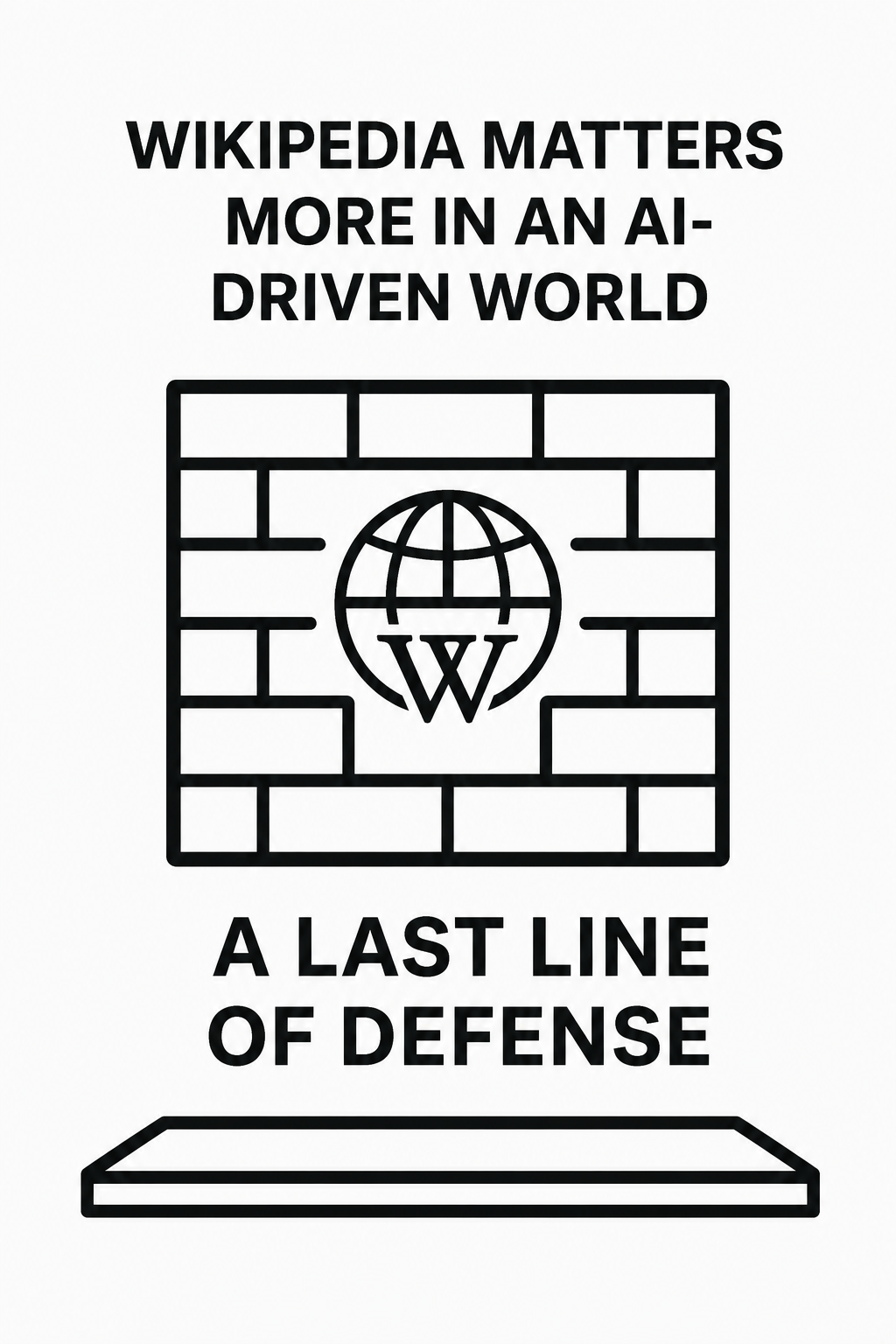
In a synthetic information ecosystem, Wikipedia may be the last line of defense.
A bridge between human memory and machine logic.
A commons that holds the line against forgetting.
Its importance has never been greater.
And its preservation — through vigilance, transparency and care — has never been more urgent.
References
- Brown, T. B., Mann, B., Ryder, N., Subbiah, M., Kaplan, J., Dhariwal, P., … & Amodei, D. (2020). Language models are few-shot learners. arXiv preprint arXiv:2005.14165.
- Touvron, H., Lavril, T., Izacard, G., Martinet, X., Lachaux, M. A., Lacroix, T., … & Jegou, H. (2023). LLaMA: Open and efficient foundation language models. arXiv preprint arXiv:2302.13971.
- Shumailov, I., Crowley, E. J., Clegg, T., Mullins, N., Rolland, P., Cai, C., … & Anderson, R. (2023). The curse of recursion: Training on generated data makes models forget. arXiv preprint arXiv:2305.17493.
- Wikipedia contributors. (2024). Model collapse. In Wikipedia, The Free Encyclopedia. Retrieved from https://en.wikipedia.org/wiki/Model_collapse
- Nature. (2024). AI models collapse when trained on AI-generated data. Nature, 627(7999). https://www.nature.com/articles/s41586-024-07566-y
Related Blogs

Make Your Site Machine-Literate: The LLM-Ready Homepage Checklist
In an era where search engines and AI assistants answer questions directly, your website isn’t just a brochure. It’s the canonical place machines look to anchor your facts. If you structure it correctly, you reduce errors, disambiguate your brand and executives, and give models a stable source to summarize.
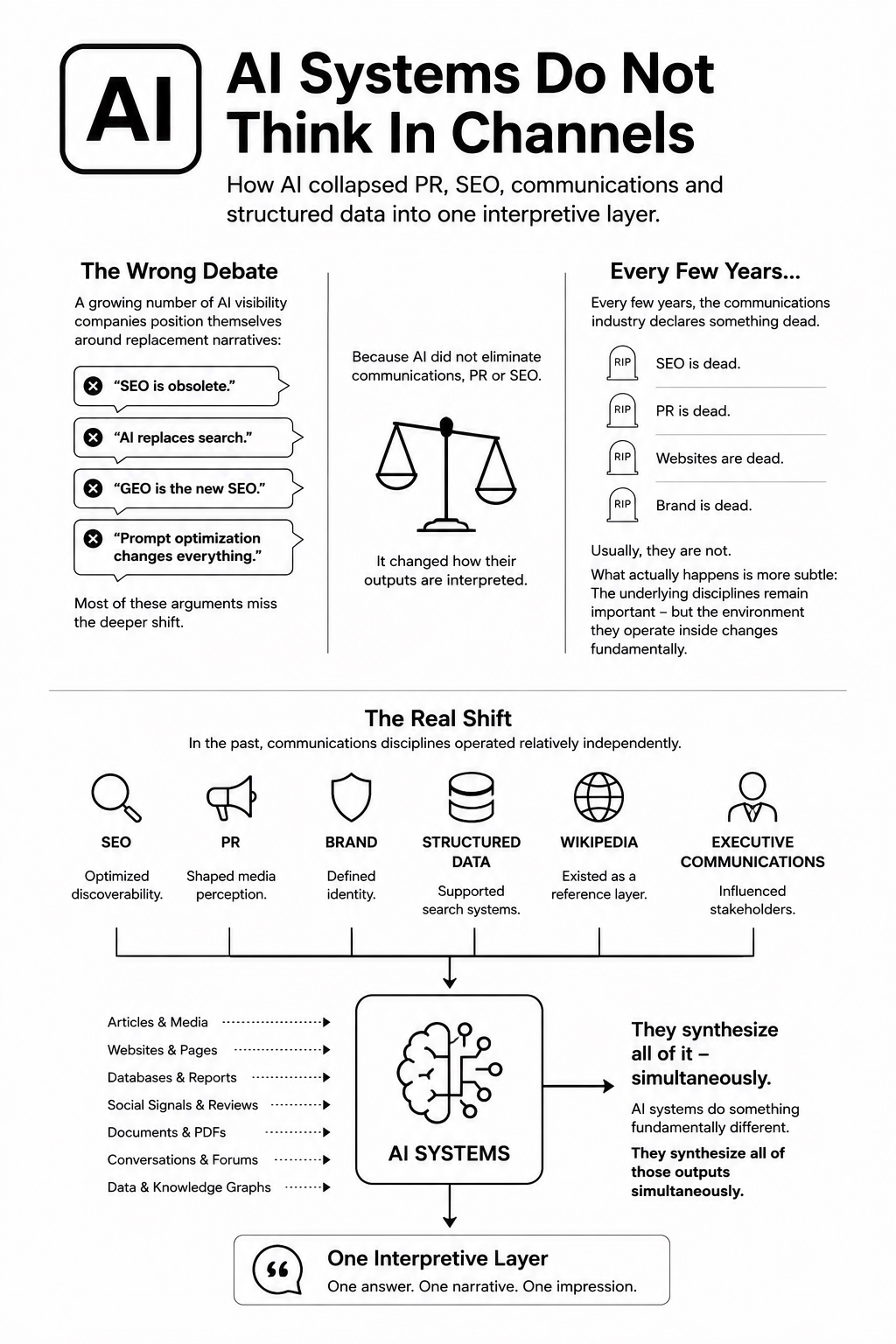
How AI collapsed PR, SEO, communications and structured data into one interpretive layer.
AI Systems Do Not Think In Channels. Every few years, the communications industry declares something dead.

How Can I Influence What AI Says About My Company?
For decades, organizations have managed how they are perceived.
For decades, organizations have managed how they are perceived. They invested in branding, communications, public relations, investor relations, search visibility and reputation management. The assumption was simple: if stakeholders wanted to understand a company, they would read its website, news coverage, analyst reports or social media presence.

.png)