

How Do AI Systems Form an Understanding of Organizations?



How Do AI Systems Form an Understanding of Organizations?
When people think about artificial intelligence, they often imagine a system retrieving information.
A user asks a question.
The AI finds an answer.
The process appears straightforward.
But beneath the surface, something more complex is happening.
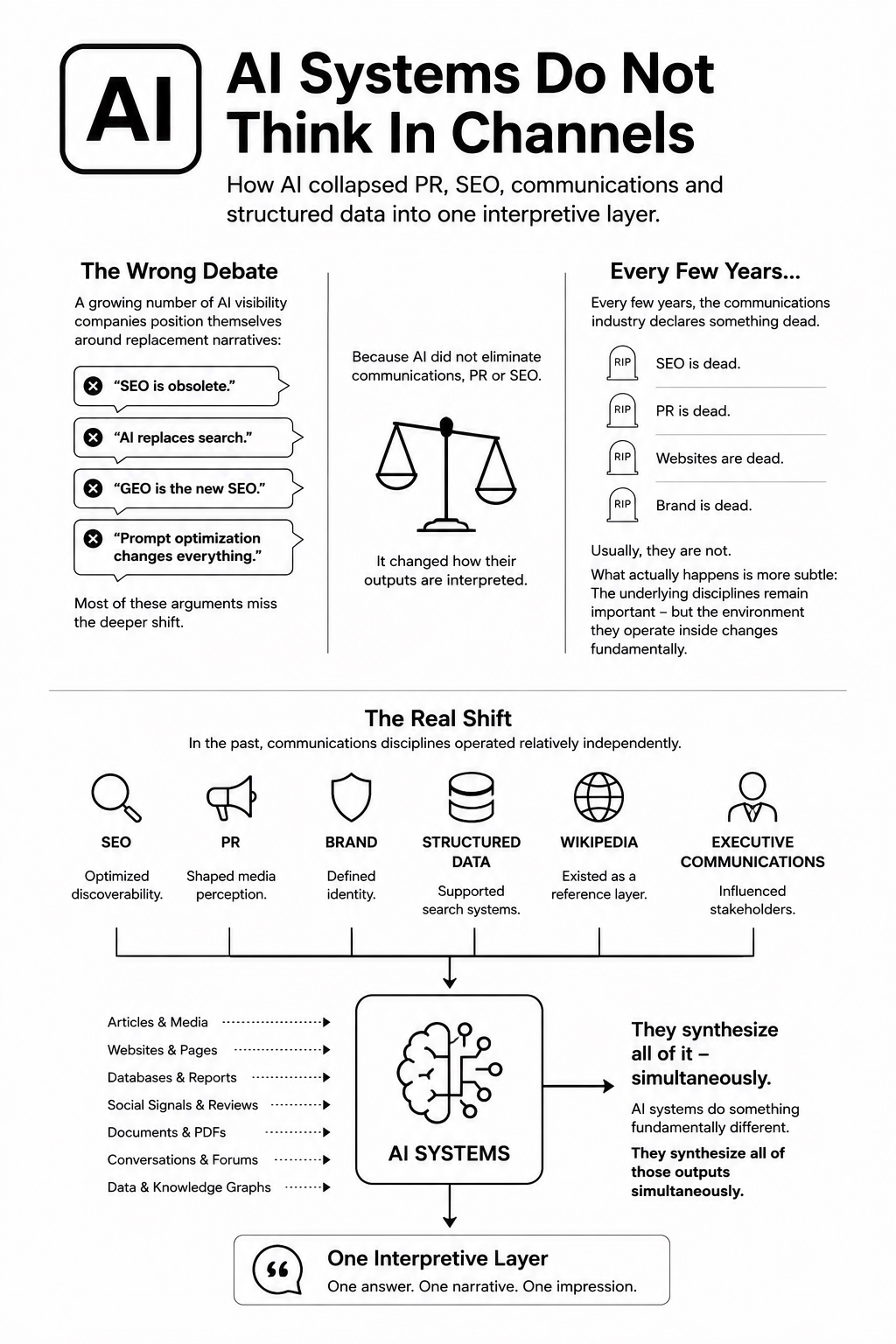
Modern AI systems do not simply retrieve information about organizations.
They construct an understanding.
This raises a fundamental question:
How do AI systems form an understanding of organizations?
As AI increasingly influences how organizations are discovered, understood and evaluated, this question is becoming important not only for researchers, but also for executives, communications professionals and policymakers.
Organizations Are Not Data Points
An organization is more than a collection of facts.
Organizations have:
- Histories
- Products
- Services
- Brands
- Leadership teams
- Reputations
- Relationships
- Strategies
- Cultures
Human beings combine these elements into a mental model.
We form an impression.
We develop an understanding.
AI systems appear to do something similar.
When asked about an organization, they do not merely list facts.
They generate descriptions, summaries, comparisons, judgments and explanations.
In other words:
They produce representations.
From Information to Understanding
One of the central challenges in artificial intelligence is transforming information into understanding.
An AI system may encounter thousands of references to an organization across:
- Websites
- News articles
- Wikipedia
- Social media
- Financial reports
- Interviews
- Research papers
- Public records
The challenge is not accessing information.
The challenge is determining what that information means.
To answer a question about an organization, an AI system must implicitly decide:
- Which information matters?
- Which information is trustworthy?
- Which information is recent?
- Which information is representative?
- Which information should be ignored?
These decisions influence the representation that emerges.
Signals Become Meaning
Organizations continuously emit signals.
Some signals are intentional.
Others are not.
Examples include:
- Official communications
- Press coverage
- Employee discussions
- Customer reviews
- Public documents
- Structured data
- Industry references
Individually, these signals provide limited insight.
Together, they begin to form a picture.
The process through which AI systems transform signals into representations remains one of the most important questions in machine understanding.
Why Different AI Systems Reach Different Conclusions
An interesting observation is that different AI systems sometimes describe the same organization differently.
ChatGPT may emphasize one aspect.
Gemini may emphasize another.
Claude may focus on something else entirely.
This suggests that AI systems are not simply retrieving stored descriptions.
Instead, they are constructing representations through processes of weighting, synthesis and interpretation.
The same signal environment can therefore produce different machine understandings.
This phenomenon raises important questions about consistency, reliability and representation.
The Missing Discipline
Historically, organizations have studied:
- Brand perception
- Reputation
- Public opinion
- Media coverage
- Search visibility
These disciplines focus primarily on human understanding.
What has been largely missing is a framework for understanding machine understanding.
As AI systems become intermediaries between organizations and stakeholders, this gap becomes increasingly important.
Organizations now face a new challenge:
Understanding how machine systems understand them.
The APL Question
AI Perception Layering™ begins with a simple research question:
How does a machine system form an understanding of an entity based on available signals?
This question sits at the intersection of:
- Artificial Intelligence
- Information Retrieval
- Knowledge Representation
- Communications
- Reputation Research
- Organizational Studies
Rather than focusing solely on AI outputs, the question focuses on the formation of machine understanding itself.
Toward Organizational Representation
Humans form perceptions.
Organizations build reputations.
AI systems construct representations.
Understanding how those representations emerge may become increasingly important as AI systems shape decisions made by:
- Customers
- Investors
- Journalists
- Employees
- Governments
- Business partners
The ability to measure, evaluate and improve machine representations may eventually become as important as measuring human perceptions.
A Research Opportunity
Many questions remain unanswered.
For example:
- How do AI systems weigh competing signals?
- Why do different AI systems arrive at different representations?
- Which signals have the greatest influence on machine understanding?
- How stable are AI representations over time?
- How closely do machine representations align with human perceptions?
These questions are not only commercially relevant.
They represent a significant opportunity for academic research.
Conclusion
For decades, organizations focused on understanding how humans perceive them.
Today, a new challenge is emerging.
Organizations must also understand how machines understand them.
The shift from human perception to machine representation may become one of the defining communications and governance challenges of the AI era.
The question is no longer simply:
“What information about our organization exists?”
The deeper question is:
“How does an AI system transform that information into understanding?”
Understanding that process is the starting point for understanding AI Representation, Organizational Representation and ultimately AI Perception Layering™.
Related Blogs

What AI Forgot: The Silent Power of Wikipedia
Inside the crowdsourced mind that still teaches the machines — how our last human knowledge source became the backbone of artificial intelligence and why we can’t afford to lose it in an AI-driven world.

Make Your Site Machine-Literate: The LLM-Ready Homepage Checklist
In an era where search engines and AI assistants answer questions directly, your website isn’t just a brochure. It’s the canonical place machines look to anchor your facts. If you structure it correctly, you reduce errors, disambiguate your brand and executives, and give models a stable source to summarize.

.png)