

How AI collapsed PR, SEO, communications and structured data into one interpretive layer.

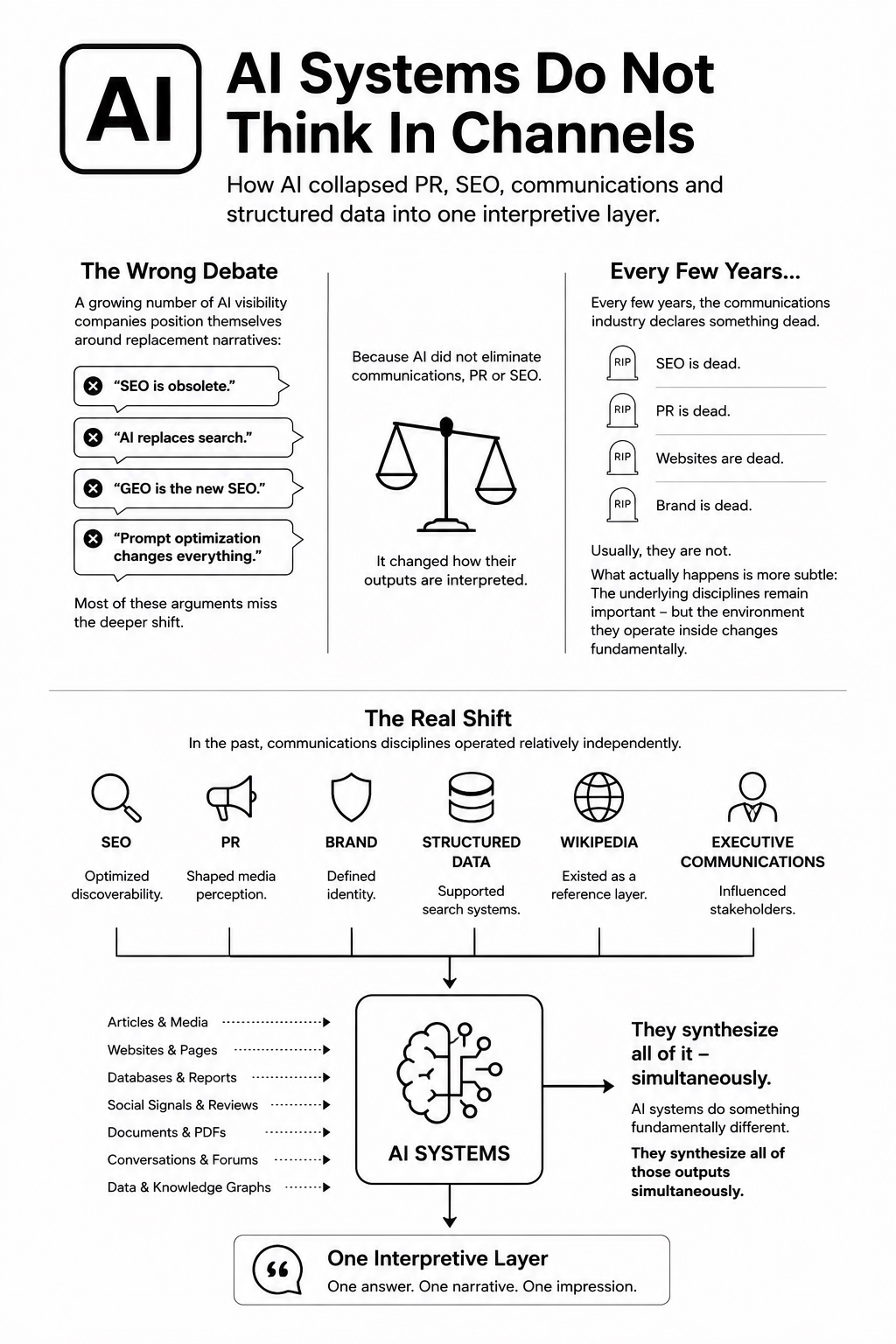

How AI collapsed PR, SEO, communications and structured data into one interpretive layer.
Every few years, the communications industry declares something dead.
SEO is dead.
PR is dead.
Websites are dead.
Brand is dead.
Usually, they are not.
What actually happens is more subtle:
The underlying disciplines remain important — but the environment they operate inside changes fundamentally.
That is what is happening now with AI.
The Wrong Debate
A growing number of AI visibility companies position themselves around replacement narratives:
- “SEO is obsolete.”
- “AI replaces search.”
- “GEO is the new SEO.”
- “Prompt optimization changes everything.”
Most of these arguments miss the deeper shift.
Because AI did not eliminate communications, PR or SEO.
It changed how their outputs are interpreted.
The Real Shift
In the past, communications disciplines operated relatively independently.
SEO optimized discoverability.
PR shaped media perception.
Brand defined identity.
Structured data supported search systems.
Wikipedia existed as a reference layer.
Executive communications influenced stakeholders.
Each discipline produced outputs for different environments.
But AI systems do something fundamentally different.
They synthesize all of those outputs simultaneously.
That changes everything.
AI Systems Do Not Think In Channels
Large language models do not distinguish between:
- PR
- SEO
- structured data
- executive messaging
- media coverage
- community discussion
- knowledge systems
The way organizations historically did.
Instead, AI systems absorb signals from all of them and compress them into a generated interpretation.
That interpretation increasingly becomes:
- the first impression
- the summary
- the explanation
- the recommendation
- the narrative
This is why organizations are beginning to notice a strange phenomenon:
AI-generated perception often feels disconnected from their intended messaging.
Not because communications stopped mattering.
But because communications now exist inside a shared interpretive system.
The Collapse Into One Layer
Search engines primarily indexed information.
AI systems synthesize meaning.
That distinction is critical.
A traditional search engine might show:
- your website
- news articles
- Wikipedia
- LinkedIn profiles
- reviews
- analyst coverage
Separately.
An AI system compresses all of it into:
one narrative.
This creates a new strategic reality.
PR no longer influences only journalists.
SEO no longer influences only search visibility.
Executive interviews no longer influence only investors.
All of these signals now converge inside AI-generated interpretation.
This Is Where Most Organizations Are Unprepared
Many companies still operate with fragmented communications structures:
- SEO teams
- PR agencies
- social media teams
- executive communications
- structured data specialists
- reputation management firms
Each optimizing their own channel.
But AI systems do not consume channels.
They consume interconnected signals.
This creates a coordination problem most organizations are not yet structured to solve.
Reputation Is Becoming Infrastructure
This is why reputation can no longer be treated purely as messaging.
In an AI-driven environment, reputation behaves more like infrastructure:
- interconnected
- persistent
- machine-readable
- reinforced over time
The question is no longer simply:
“What are we communicating?”
It becomes:
“What interpretation emerges from our total signal environment?”
That is a fundamentally different strategic challenge.
AI Perception Layering™
AI Perception Layering™ (APL) was created to address this shift.
Not as a replacement for:
- PR
- SEO
- communications
- structured data
- reputation management
But as a framework for understanding how they now interact inside AI systems.
APL studies:
- signal architecture
- narrative construction
- machine-readable identity
- knowledge systems
- reinforcement dynamics
- AI-generated interpretation
In other words:
APL is not about replacing communications.
It is about understanding how communications are interpreted by machines.
The Next Strategic Layer
The organizations that adapt successfully to the AI era will not necessarily produce the most content.
They will build the most coherent signal ecosystems.
Because increasingly:
- trust
- discoverability
- authority
- reputation
- positioning
will emerge from how AI systems synthesize available information.
Not from isolated campaigns.
Not from individual channels.
And not from messaging alone.
The Future Of Communications
The future is not:
- PR versus AI
- SEO versus AI
- humans versus machines
The future is:
- understanding how machine interpretation shapes human perception.
That is the new strategic layer.
And most organizations have only started to realize it.
Related Blogs
What AI Forgot: The Silent Power of Wikipedia
Inside the crowdsourced mind that still teaches the machines — how our last human knowledge source became the backbone of artificial intelligence and why we can’t afford to lose it in an AI-driven world.

Make Your Site Machine-Literate: The LLM-Ready Homepage Checklist
In an era where search engines and AI assistants answer questions directly, your website isn’t just a brochure. It’s the canonical place machines look to anchor your facts. If you structure it correctly, you reduce errors, disambiguate your brand and executives, and give models a stable source to summarize.

How Can I Influence What AI Says About My Company?
For decades, organizations have managed how they are perceived.
For decades, organizations have managed how they are perceived. They invested in branding, communications, public relations, investor relations, search visibility and reputation management. The assumption was simple: if stakeholders wanted to understand a company, they would read its website, news coverage, analyst reports or social media presence.

.png)