

AI Is Becoming the Super-Multiplier of Organizational Reputation


AI Is Becoming the Super-Multiplier of Organizational Reputation
What happens when one new class of information intermediaries increasingly influences how customers, journalists, investors, employees, policymakers and business partners understand your organization?
Organizations communicate with different audiences through different channels. Public Relations addresses journalists. Investor Relations communicates with financial markets. Marketing reaches customers. Employer Branding speaks to employees. Public Affairs engages with policymakers.
AI systems are beginning to change this structure.
Customers ask AI about companies before making decisions. Journalists use AI for research. Investors analyze organizations with AI assistants. Candidates ask AI about potential employers. Executives use AI to understand competitors and business partners.
Different stakeholders are increasingly turning to the same new class of information intermediaries.
AI systems are becoming the super-multipliers of organizational reputation.
From Separate Channels to a Shared Intermediary
The fundamental change is structural.
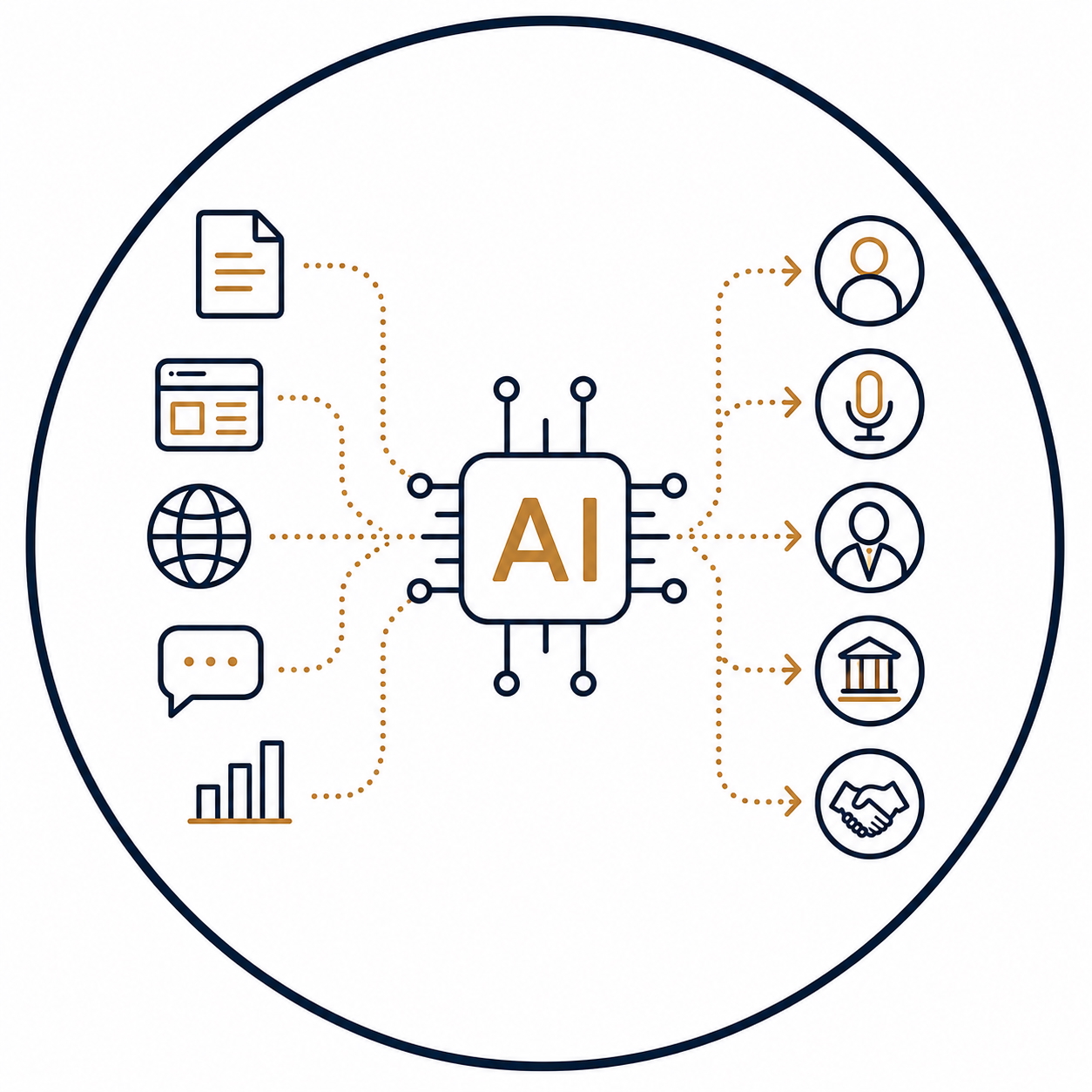
Organizational information no longer reaches stakeholders only through separate channels. AI systems can access, process and synthesize information from across the digital environment and generate direct answers about organizations.
And those answers can reach anyone.
A customer. A journalist. An investor. An employee. A policymaker. A business partner.
The same class of systems increasingly sits between organizations and many of their most important stakeholders.
Many Signals Go In. One Representation Comes Out.
Every organization is surrounded by signals: corporate websites, news coverage, executive interviews, financial reports, Wikipedia, structured data, LinkedIn, YouTube, industry publications, reviews and community discussions.
Traditionally, these signals were created and managed by different functions. Communications focused on media. Marketing focused on customers. Investor Relations focused on financial markets. HR focused on employees.
AI systems do not necessarily respect these organizational boundaries.
They can interpret information from across the digital environment and use it to construct a representation of the organization.
Many signals go in. A machine representation comes out. And that representation can reach every stakeholder group.
The Super-Multiplier Effect
This is what makes AI fundamentally different from previous information intermediaries.
Media distributes information. Search engines help people find it. Social networks amplify it.
AI systems interpret information, synthesize it and generate answers.
When someone asks an AI system about an organization, the result is no longer simply a list of sources. It can be a direct description, evaluation or recommendation.
The questions may be different. A journalist asks about controversies. An investor asks about reputation risks. A candidate asks about the company as an employer. A customer asks whether the organization can be trusted.
Different audiences. Different questions.
But the answers may emerge from the same underlying machine representation.
This is the multiplier effect.
An inaccurate, fragmented or outdated representation is no longer confined to one audience or channel. It can potentially influence multiple stakeholder groups at the same time.
The opposite is equally important: a strong and coherent machine representation can become a strategic asset.
Organizations Are Not Structured for This Yet
Most organizations still manage reputation through separate functions.
Communications manages media. Marketing manages content. Investor Relations manages financial communication. HR manages employer reputation. Public Affairs manages political stakeholders. Digital teams manage websites and structured information.
Each function creates signals.
But who is responsible for the representation that emerges when AI systems interpret all of these signals together?
In most organizations, the answer is unclear.
AI representation does not fit neatly within one department because the signals shaping it originate across the entire organization—and beyond it.
AI Is More Than a New Stakeholder
AI systems are often described as a new audience or stakeholder. But their role goes further.
They do not simply consume organizational information.
They can interpret it, synthesize it and redistribute the resulting representation to almost every other stakeholder group.
AI is not simply another audience. It is a new intermediary to almost every audience.
That is what makes it a super-multiplier.
The Strategic Question Has Changed
Organizations still need to ask what they should communicate, which audiences they want to reach and which channels they should use.
But another question is becoming increasingly important:
What representation emerges when AI systems interpret the signals surrounding our organization—and then redistribute that representation to our stakeholders?
This is the question AI Perception Layering addresses.
APL examines how organizational messages become signals, how those signals exist across different layers and how their interaction contributes to machine representation.
Because when AI becomes a super-multiplier, managing individual channels is no longer enough.
Organizations must understand what is being multiplied.
Conclusion
Customers, journalists, investors, employees, policymakers and business partners increasingly use AI systems to research, evaluate and understand organizations.
This creates a fundamental shift in reputation management.
One new class of information intermediaries can increasingly influence how almost every stakeholder group understands an organization.
AI systems are becoming the super-multipliers of organizational reputation.
And the most important question is no longer simply how far information travels.
It is what representation gets multiplied.

Related Blogs

What AI Forgot: The Silent Power of Wikipedia
Inside the crowdsourced mind that still teaches the machines — how our last human knowledge source became the backbone of artificial intelligence and why we can’t afford to lose it in an AI-driven world.

Make Your Site Machine-Literate: The LLM-Ready Homepage Checklist
In an era where search engines and AI assistants answer questions directly, your website isn’t just a brochure. It’s the canonical place machines look to anchor your facts. If you structure it correctly, you reduce errors, disambiguate your brand and executives, and give models a stable source to summarize.

.png)