
The Business Decisions Your Organization Is Not Managing
Every organization manages the factors that influence its business: revenue, margins, market share, risk, reputation and customer behavior. Companies invest significant resources in understanding what affects the decisions of customers, investors, employees and business partners.



The Business Decisions Your Organization Is Not Managing
Every organization manages the factors that influence its business: revenue, margins, market share, risk, reputation and customer behavior. Companies invest significant resources in understanding what affects the decisions of customers, investors, employees and business partners.
Yet a new factor is entering these decisions: AI.
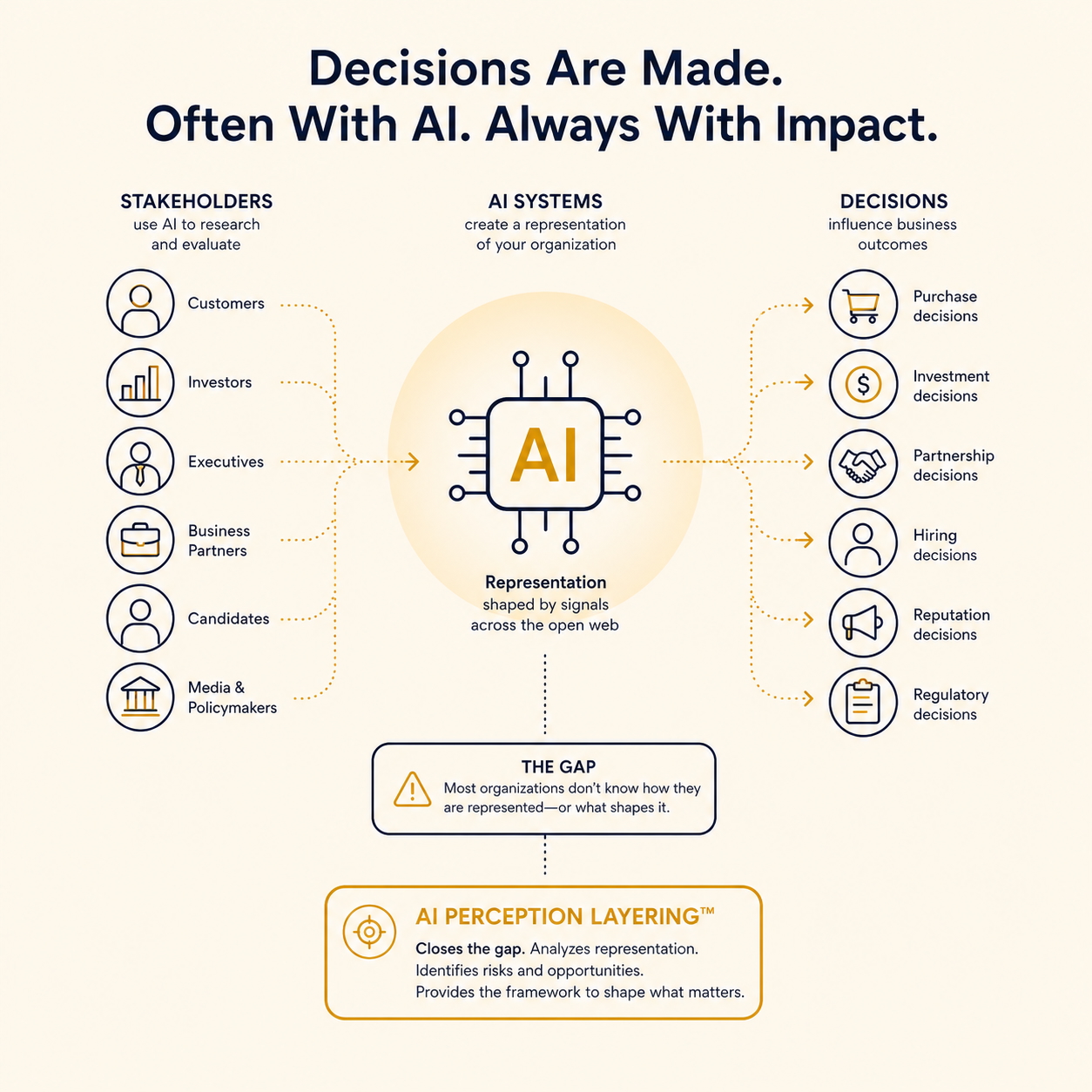
Customers use AI to compare companies and products. Investors use it for research. Executives evaluate markets, competitors and potential partners. Candidates research employers. Journalists and policymakers use AI to understand organizations and industries.
The economic logic is straightforward: stakeholders increasingly use AI before making decisions about organizations. Yet most organizations have little understanding of the representation those stakeholders encounter.
The Decisions You Never See
Consider an executive evaluating two companies for a major contract. Before initiating discussions, they ask an AI system to compare them. Which company is more innovative? Which has the stronger market position? What are the major risks? Which management team appears more credible?
The answers contribute to the executive’s understanding of both organizations. They may confirm an existing opinion, introduce a new concern or determine which company receives the first call.
The companies may never know that this interaction occurred. It will not appear in their CRM, website analytics or customer journey.
Yet an AI-generated representation may have influenced a commercially relevant decision.
A New Management Gap
Organizations carefully manage investor information, customer journeys, reputation, brand awareness and search visibility. But when stakeholders use AI to research and evaluate an organization, a new intermediary enters the decision-making process.
Most organizations cannot answer three fundamental questions:
How are we represented by AI systems? What shapes that representation? How does it influence the decisions of our most important stakeholders?
The issue is not whether a single AI-generated answer directly causes financial gain or loss. Business decisions rarely work that way.
The issue is simpler: a new source of influence has entered economically relevant decisions, and most organizations are not managing it strategically.
Risk Is Only Half the Equation
An inaccurate, outdated or fragmented representation can create business risk. But missed opportunities may be equally significant.
An organization may invest heavily in innovation, sustainability, new markets or strategic transformation. If these developments are not reflected in how AI systems represent the organization, stakeholders using AI to research and evaluate it may never fully encounter them.
The organization has changed. The machine representation has not.
The resulting gap can influence how the company is researched, compared and evaluated.
From AI Visibility to Business Relevance
Much of the current discussion around AI visibility focuses on a simple question: What does ChatGPT say about us?
For organizations, that question does not go far enough.
The more important questions are: Who is asking? What decision are they making? What representation are they receiving? And what is shaping that representation?
A negative AI answer about an irrelevant topic may have little economic significance. A representation gap affecting customers, investors or business partners in a strategically important market may be considerably more relevant.
This is why AI representation should not be treated simply as another communications or visibility metric. Its relevance depends on the business decisions it can influence.
From Observation to Strategic Management
Organizations cannot control every AI-generated answer. Nor do they need to.
But they need to understand how they are represented, where that representation creates business risks or missed opportunities, and what shapes it.
This is where AI Perception Layering begins.
AI Perception Layering analyzes how an organization is represented by AI systems, identifies business risks and missed opportunities, and provides the strategic framework to actively shape that representation.
The objective is not simply to generate better AI answers. It is to manage an increasingly important factor in how stakeholders understand, evaluate and make decisions about an organization.
Conclusion
AI is becoming part of how business decisions about organizations are made. These decisions may concern purchases, investments, partnerships, employment or regulation. The organization may never see the AI interaction that influenced them, but it may experience the economic consequences.
This creates a new management challenge.
Stakeholders increasingly make decisions based on representations that most organizations neither understand nor strategically manage.
The question for CEOs and CFOs is therefore no longer simply:
What does AI say about our organization?
It is:
Which business decisions are already being influenced by our AI representation—and who is managing it?
Related Blogs

How Can I Influence What AI Says About My Company?
For decades, organizations have managed how they are perceived.
For decades, organizations have managed how they are perceived. They invested in branding, communications, public relations, investor relations, search visibility and reputation management. The assumption was simple: if stakeholders wanted to understand a company, they would read its website, news coverage, analyst reports or social media presence.

Why Does AI Describe Our Company Incorrectly?
One of the biggest misconceptions about AI is the idea that it stores a single description of every organization.


.png)